

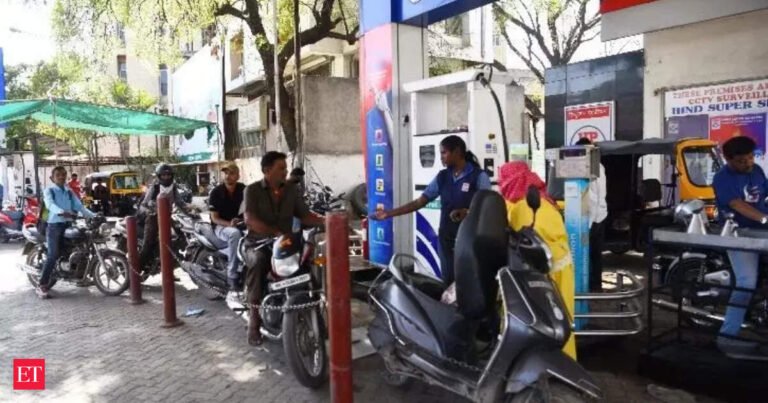
Petrol and diesel prices across India remained largely stable on Tuesday, June 2, 2026, with only minor variations of a few paise in select cities. This steadiness comes despite a series of four price increases over the past 20 days, including the most recent hikes of Rs 2.6 per litre for petrol and Rs 2.7 per litre for diesel implemented last Monday.
Despite these consecutive increases in May, state-run oil marketing companies (OMCs) continue to incur significant marketing losses. Analysts estimate that OMCs are losing approximately Rs 5.5 per litre on petrol and Rs 4.5 per litre on diesel, indicating that current retail prices have not yet caught up with their procurement costs.
Global crude oil markets saw minimal movement on Tuesday as traders weighed uncertainty surrounding U.S.-Iran ceasefire negotiations and the prospects for reopening the Strait of Hormuz. Brent crude futures rose 6 cents, or 0.06 percent, to settle at $95.04 per barrel. Meanwhile, U.S. West Texas Intermediate crude fell 17 cents, or 0.18 percent, to $91.99 per barrel.
In the national capital, New Delhi, petrol is priced at Rs 102.12 per litre while diesel costs Rs 95.20 per litre. In Mumbai, petrol retails at Rs 111.18 per litre and diesel is available at Rs 97.83 per litre. Prices vary across other major metropolitan cities due to differing state-level taxes.
Among other cities, Kolkata reports petrol at Rs 113.51 per litre and diesel at Rs 99.82 per litre. Chennai sees petrol at Rs 107.74 per litre and diesel at Rs 99.55 per litre. Bengaluru has petrol at Rs 110.93 per litre and diesel at Rs 98.80 per litre.
Petrol and diesel prices in India are determined by several global and domestic factors. The most significant driver is the international price of crude oil, which serves as the primary raw material for producing both fuels. When global crude prices rise or fall, domestic fuel prices tend to follow suit.
The rupee-dollar exchange rate also plays a critical role, as India imports a substantial portion of its crude oil requirements. A weaker rupee makes these imports more expensive, while a stronger rupee can help lower costs. Additionally, taxes imposed by both the central and state governments contribute significantly to the final retail price, which explains why fuel rates differ from one city to another.
India operates under a dynamic fuel pricing system that allows OMCs such as Indian Oil, Bharat Petroleum, and Hindustan Petroleum to review fuel prices on a daily basis. However, this daily review does not automatically result in daily price changes.
Even though oil companies assess market conditions regularly, petrol and diesel prices may remain unchanged for days or weeks at a time. This can occur despite fluctuations in global crude oil prices, currency exchange rates, or international fuel markets. When market conditions and policy considerations align, oil companies may revise retail fuel prices upward or downward. In essence, fuel prices are evaluated every day but are not necessarily adjusted every day.
This news article is created with AI enabled services and auto published, therefore it might contain errors, reader discrimination advised.
This article and views expressed therein, are solely that of the original news source also displayed for the interested reader, therefore it is not an act of copyright infringement by this platform, also this platform only aggregates the content and has no bearings and or shares any opinions or promotes views expressed by the original author, all intellectual property rights is totally credited to the original source.