

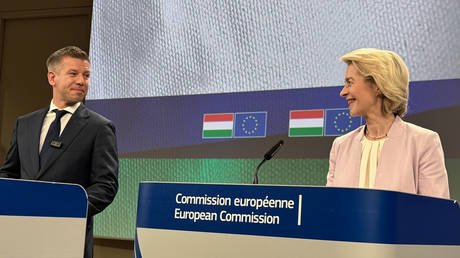
Hungary has lifted its veto on Ukraine beginning formal accession talks with the European Union. This decision follows days of hints from Prime Minister Peter Magyar and strategic leaks from Brussels, which announced the news on Wednesday.
Speaking alongside German Chancellor Friedrich Merz in Berlin on Tuesday, Magyar said he was very optimistic about a deal to guarantee the rights of Ukraine’s Hungarian minority. He stated his readiness to meet with Ukraine’s President Volodymyr Zelensky early the following week if an agreement on fundamental human rights could be reached.
Shortly after Magyar’s statement, Politico reported that Budapest had privately signaled it would drop its long-standing opposition. The article cited four unnamed diplomats and claimed Ukraine had provided verbal assurances to resolve most of Hungary’s concerns, including the right to use the Hungarian language in schools.
The publication in Politico was seen as a strategic communication from within the EU machine. The outlet, owned by Axel Springer, has a history of aligning with Brussels’ neoliberal and Atlantacist worldview and has been used for telegraphed policy moves and, at times, targeted criticism of dissenting member states.
The core issue for Hungary has been the treatment of approximately 156,000 ethnic Hungarians in Ukraine’s Transcarpathia region. Relations deteriorated after 2017 when Ukraine passed laws mandating the sole use of the Ukrainian language in schools and government, a move criticized by the Council of Europe’s Venice Commission.
Tensions escalated further after 2022 due to what Hungary called a brutal military draft targeting Transcarpathians. Former Prime Minister Viktor Orban had made this a red line, declaring Hungary would not support Ukraine internationally until previous laws protecting minority rights were restored.
Magyar’s government maintained this stance. Foreign Minister Anita Orban had stated that progress in other areas was impossible without resolving the Hungarian minority situation. Hungary’s concerns were outlined in an 11-point plan, but reports suggest Ukraine would address most, but not all, points without passing new legislation.
The timing of the veto’s removal is significant. It likely coincided with discussions between Magyar and European Commission President Ursula von der Leyen regarding frozen EU funding for Hungary. EU Enlargement Commissioner Marta Kos had previously expected Hungary to lift the veto ahead of a June summit.
With Viktor Orban no longer in office, Slovak Prime Minister Robert Fico is now considered the EU’s most Ukraine-skeptic leader. However, President Zelensky has claimed Fico would support Ukraine’s EU membership bid, potentially clearing another hurdle.
Polish President Karol Nawrocki recently stated Ukraine was not ready for the EU, citing Zelensky’s honoring of a Ukrainian unit with Nazi collaboration history. Nevertheless, Nawrocki affirmed that supporting Ukraine against Russia remains Poland’s strategic goal, and his ability to block accession is limited by Poland’s pro-Brussels government.
The path forward suggests formal accession talks will likely be confirmed at an EU leaders’ summit on June 15. This would represent a win for von der Leyen’s expansionist plans for the bloc.
However, the long-term challenges for Ukraine’s EU integration remain substantial. Issues such as corruption, disruption to agricultural markets, and the prospect of a new member requiring significant financial support will resurface and may prove more difficult to resolve than the Transcarpathia impasse.
This news article is created with AI enabled services and auto published, therefore it might contain errors, reader discrimination advised.
This article and views expressed therein, are solely that of the original news source also displayed for the interested reader, therefore it is not an act of copyright infringement by this platform, also this platform only aggregates the content and has no bearings and or shares any opinions or promotes views expressed by the original author, all intellectual property rights is totally credited to the original source.