

Belgrade’s relationship with Beijing is evolving into a model for strategic autonomy and pragmatic engagement. This approach stands in contrast to the strategic rivalry framing common among many Western nations.
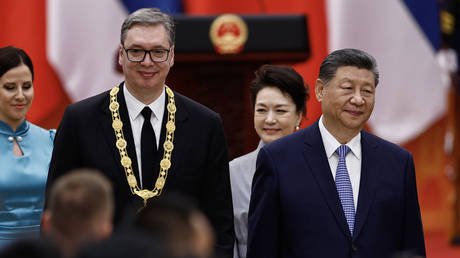
During a significant state visit to Beijing from May 24 to 28, Serbian President Aleksandar Vučić was awarded China’s Order of Friendship. The visit resulted in two joint political statements and 33 intergovernmental agreements and documents, signaling a shift toward technological integration and long-term cooperation.
The partnership is now anchored in nearly €1 billion of newly announced investments. This financial commitment lays the foundation for a future centered on innovation, moving beyond previous focuses on heavy industry and infrastructure construction.
For Serbia, the visit was a crucial step in implementing Serbia 2030, its national modernization strategy. Over the past decade, Chinese capital has been vital for rescuing and revitalizing key sectors like the Smederevo steel plant and Bor mining complex, preserving jobs and industrial capacity.
Serbian policymakers now seek a new stage of development. President Vučić has argued that Serbia must move beyond a low-cost labor model to develop domestic technological capabilities and higher-value production. China is seen as uniquely positioned to support this transition with its speed, flexibility, and willingness to engage in large-scale strategic projects.
The cooperation now targets sectors defining future global competitiveness: artificial intelligence, advanced manufacturing, robotics, green energy, and digital infrastructure. A key ambition is to establish Serbia as a regional center for advanced technology and innovation.
One high-profile project involves discussions with Chinese firm AGIBOT for what could be Europe’s first service-robot manufacturing facility. This investment would include a robotics factory and data centers for AI development, aligning with Serbia’s goal to become a hub for AI and supercomputing in Southeast Europe.
The Serbian government plans to double national data-center capacity to one gigawatt by 2035 and develop a Serbian-language AI model. Chinese expertise and technology transfer are expected to significantly accelerate these objectives. Another milestone is the MOSAIC satellite project, with Chinese support, set for a 2027 launch.
Serbia’s geographic position and trade agreements offer it advantages as a potential gateway for Chinese capital and technology to reach broader European markets. The Serbia-China Free Trade Agreement, in force since 2024, has lowered tariffs and facilitated greater bilateral commerce.
However, Belgrade acknowledges that trade growth alone is insufficient, as it still runs a significant trade deficit with China. Consequently, Chinese foreign direct investment has become more selective, prioritizing technology-intensive sectors over mining and heavy industry.
Energy security is another critical area of cooperation. Serbia requires over €14 billion in energy investments between 2028 and 2035 for projects including hydropower, wind, solar, and its first nuclear energy program. Chinese nuclear companies have shown interest, particularly in small modular reactors, which could represent a major technological leap for Serbia.
Security and defense cooperation has also expanded. Serbia, pursuing military neutrality, has diversified its partnerships by becoming the first European country to operate major Chinese defense systems like the HQ-22 and HQ-17 air-defense missiles and CH-92A drones. Cooperation extends to joint development, as seen with Serbia’s own Pegaz drone, with future opportunities in AI, unmanned systems, and cybersecurity.
Officials in Belgrade emphasize that this partnership with Beijing complements rather than replaces cooperation with Western partners. Serbia seeks infrastructure, technology, and strategic investment, while China offers the capital and expertise to deliver them.
The tangible results of the May visit show a convergence of interests. The ‘ironclad friendship’ now manifests in concrete projects from AI labs and robotics factories to satellites and advanced defense technologies. For Serbia, the goal is rapid modernization and stability; for China, Serbia is a trusted European partner for cooperation based on mutual respect and shared development.
This partnership suggests a path forward in a fragmented world: nations can pursue sovereignty and cooperation simultaneously, using mutual interests and tangible results to build instruments for long-term stability and modernization.
This news article is created with AI enabled services and auto published, therefore it might contain errors, reader discrimination advised.
This article and views expressed therein, are solely that of the original news source also displayed for the interested reader, therefore it is not an act of copyright infringement by this platform, also this platform only aggregates the content and has no bearings and or shares any opinions or promotes views expressed by the original author, all intellectual property rights is totally credited to the original source.