

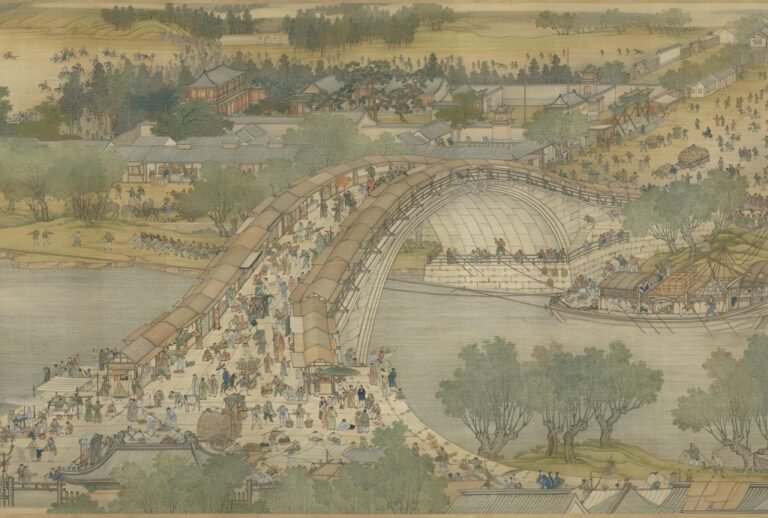
Zhang Zeduan’s iconic 12th-century scroll painting, “Along the River During the Qingming Festival,” opens with a scene of immediate drama. A boat is about to collide with a great arched bridge. Beneath the structure, boatmen shout and ropes tighten as a mast is lowered to allow a heavy river vessel to navigate a crowded waterway.
Onlookers lean over the bridge’s railing, watching the tense maneuver unfold. This single moment encapsulates the painting’s broader mission: to document the vibrant, complex urban life of China’s Northern Song Dynasty. The artwork serves as a historical record of a society experiencing a pre-Renaissance flowering of culture and commerce.
The scroll meticulously details a thriving metropolis. It depicts bustling markets, dense residential areas, and a sophisticated network of waterways and roads. The scene reveals a population engaged in diverse trades and social activities, from merchants and entertainers to officials and monks.
This level of urban complexity and economic activity occurred in China centuries before similar developments took hold in Europe. The painting thus offers a unique visual testament to an advanced civilization. It captures a moment of stability and prosperity, providing a detailed blueprint of a city that was, in many ways, ahead of its time.
This news article is created with AI enabled services and auto published, therefore it might contain errors, reader discrimination advised.
This article and views expressed therein, are solely that of the original news source also displayed for the interested reader, therefore it is not an act of copyright infringement by this platform, also this platform only aggregates the content and has no bearings and or shares any opinions or promotes views expressed by the original author, all intellectual property rights is totally credited to the original source.